Data Security Posture Management (DSPM)
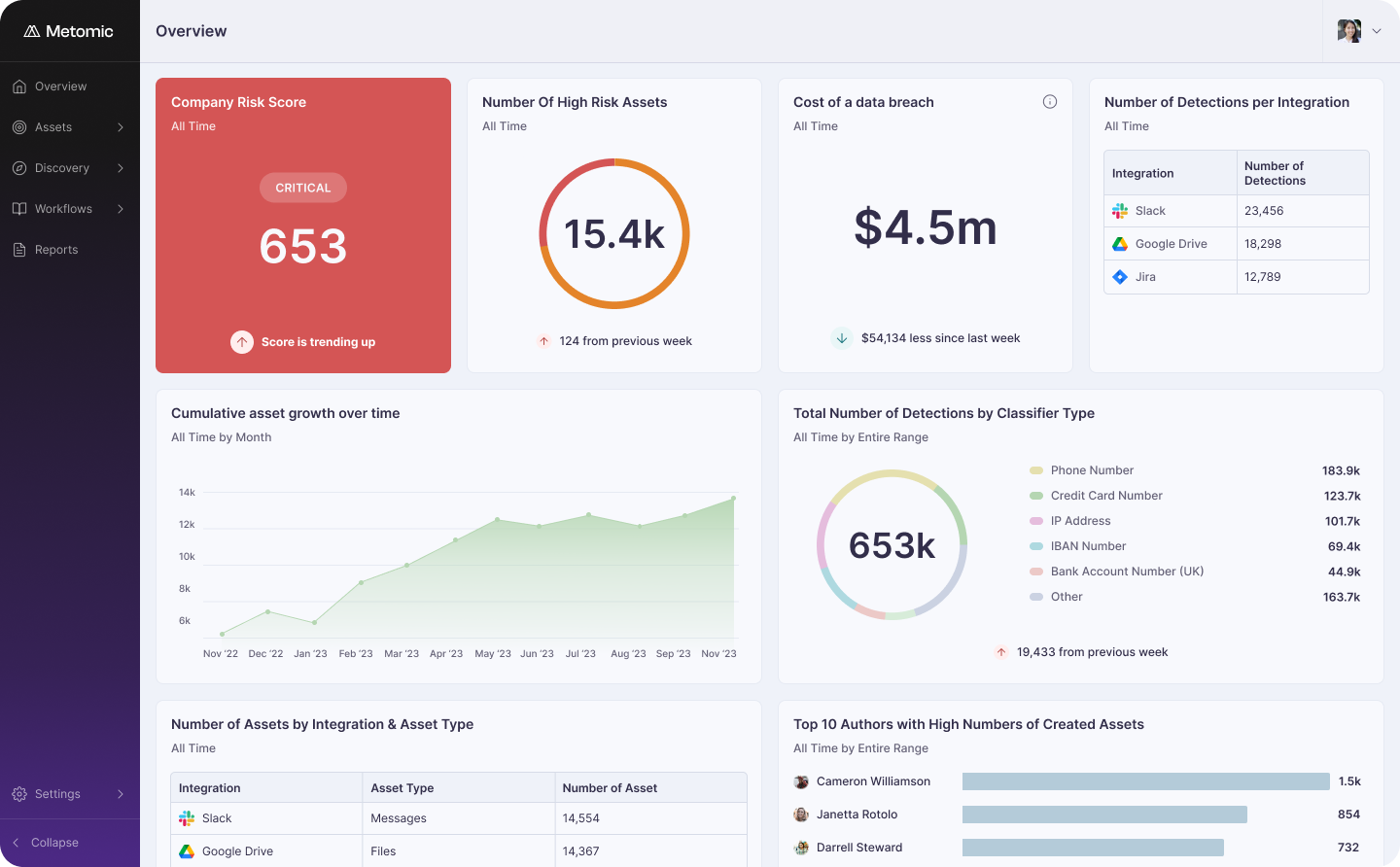
DSPM answered a question about data sitting still, and Metomic answered it for years across Google Drive, Slack, and Jira. That data now moves. Agents request it at machine speed, people paste it into AI, so Metomic moved into the path.

Trusted by SaaS enabled teams


%20logo.svg)












.png)


Where DSPM started
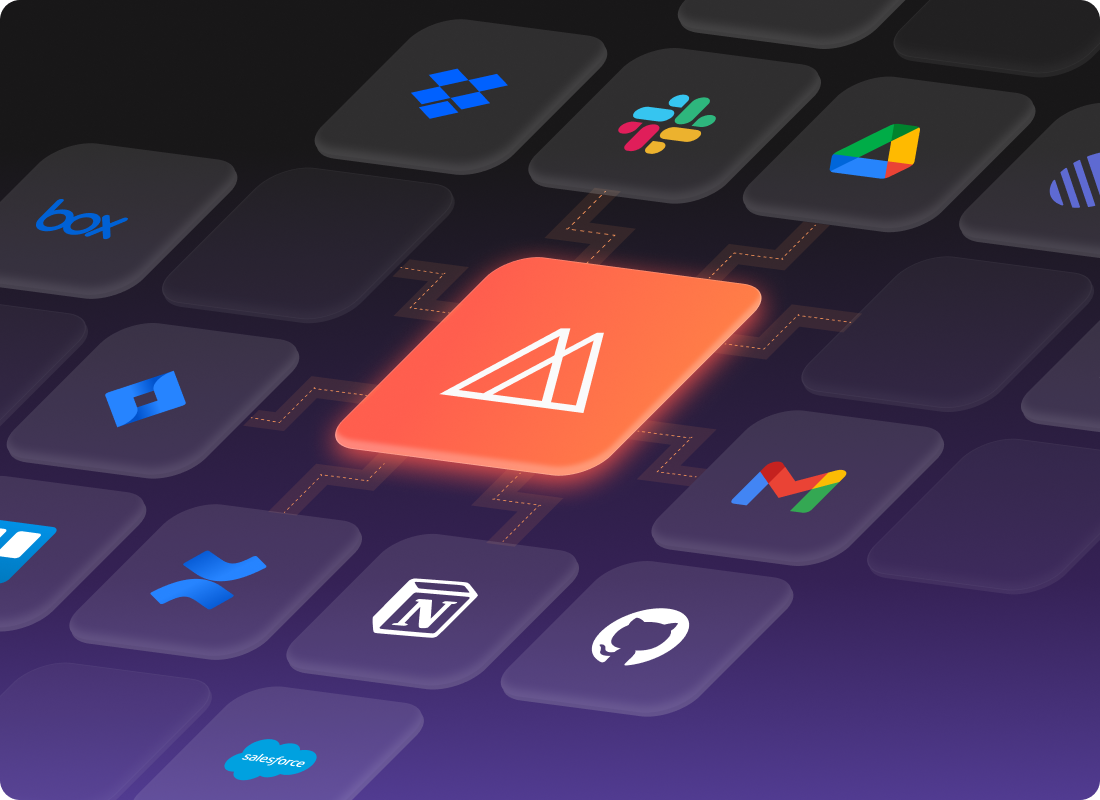
For years Metomic scanned the places your work lives, found the customer records and keys sitting in Google Drive, Slack, Jira, and Confluence, and cleaned up the sharing nobody had reviewed in years. That work still matters, and knowing your data is what the rest of this page rests on.
Then the data moved
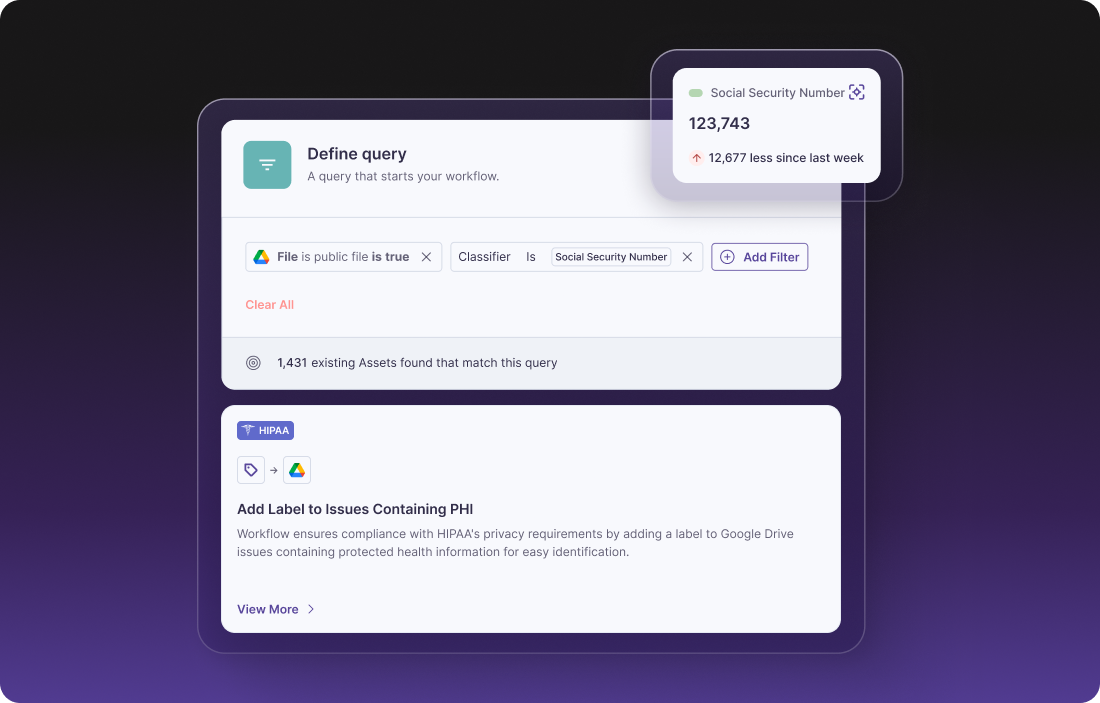
A tidy permissions model holds until an agent inherits it. Your automations reach whatever the person driving them can reach, at a speed no review cycle was built for, and your people paste customer data into whichever AI helps them finish by Friday. Posture describes that. It cannot stop it.
See what agents do, and step in
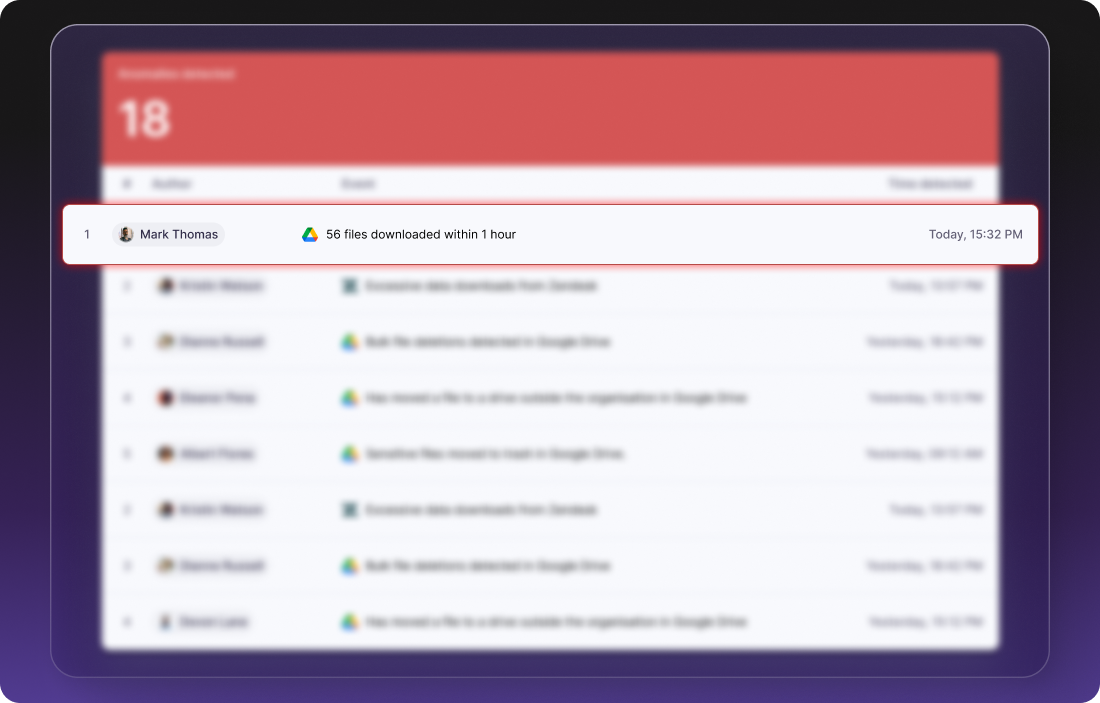
Metomic now sits in the path. Agents reach Slack, Google Workspace, and the rest through us, so each tool call is logged with who ran it, which agent, and what data came back. Metomic scans the response before the agent reads it, removes what is sensitive, and holds a risky request until someone approves.
.png)
Prove it to the regulator
The audit story improves rather than restarts. You keep the same kind of evidence DSPM gave you, now covering what your agents did and what your people ran in the browser, exported and fed to your SIEM. When a supervisor asks how your AI behaves, you answer from the record instead of from memory.

Metomic still knows what your sensitive data is. Now it decides what your agents can do with it.

See it. Control it. Prove it. The same discipline, moved to where AI works.






Connect once, and every agent gets the same rules
Set up a connector once in Metomic, and Claude, ChatGPT, Codex, Cursor and more reach it under your rules.









.png)
.png)
.png)
.png)
.png)



What our customers are saying about Metomic
Use keyboard
to navigate through testimonials

Metomic provides an excellent, easy-to-navigate interface with the necessary features to help keep our workspace secure.
.png)
We use Metomic to uncover sensitive company data and prevent it from being shared or residing in places it shouldn't. It's a really great supplement where technical controls that could be our frontline of defense don't exist.


Easy integration. It is as simple as a few clicks (and the Metomic onboarding process is excellent, too, as the team guides us through the process).

We can confidently respond, ‘Yes, we have a DLP solution in place,’ and support that claim with verifiable results. That has been crucial for establishing trust with our customers.

Having real-time data-driven insights to share with stakeholders has been invaluable. Metomic ensures that we’re compliant, secure, and proactive, providing the operational resilience necessary to grow in a competitive digital commerce market.

Metomic addresses risks efficiently—blocking unsafe data sharing or sending alerts to users. This allows our team to remain productive while keeping our data secure. The visibility and control Metomic provides has been game-changing in helping us implement a solid, proactive approach to data security.


The machine learning aspect of AI means that, when paired with security solutions such as identity verification and biometric authentication (voice or fingerprint), it improves in its detection over time, increasing accuracy but also reducing the number of false positives.


I appreciate how configurable and easy it is to setup alerting workflows. The tool is lightweight and easy to integrate into the platforms that our company uses. The customer support team has been excellent at addressing all of our company's concerns.


The big thing for me was how interactive it was in Slack. That was one of our biggest problem points and there was a solution for that immediately.


Immediately, especially for the Google Workspace document sharing, Metomic has paid for itself seven fold.


We were able to find some legacy AWS keys from years ago...that gave us the confidence that in the event of new secrets appearing insecurely across our tech stack, we could rely on Metomic to help us swiftly detect and respond in a click of a button.


Metomic is a SaaS enabler. They help us protect sensitive data in applications like Google Drive, so we can grow our business knowing our data is safe.


Having real-time data-driven insights to share with stakeholders has been invaluable. Metomic ensures that we’re compliant, secure, and proactive, providing the operational resilience necessary to grow in a competitive digital commerce market.
We are a Slack and Google shop, and Metomic had out-of-the-box integrations that made implementation a breeze.
Lorem ipsum dolor sit amet, consectetur adipiscing elit. Suspendisse varius enim in eros elementum tristique. Duis cursus, mi quis viverra ornare, eros dolor interdum nulla, ut commodo diam libero vitae erat. Aenean faucibus nibh et justo cursus id rutrum lorem imperdiet. Nunc ut sem vitae risus tristique posuere.
Questions before the rollout.
What is DSPM?
DSPM (Data Security Posture Management) helps organisations take a more holistic approach to data security. It encompasses the tools and processes security teams use to detect, monitor, and protect the organisation's sensitive data.
Companies implement DSPM tools, like Metomic, to ensure they can monitor sensitive data in real-time, and maintain compliance with industry regulations. They can provide data security insights, and enhance security policy enforcement.
What are the key components of a DSPM tool?
DSPM is designed to protect the data layer of an organisation, and ensure that sensitive data won’t be leaked or breached. DSPM tools consolidate a few different solutions in order to give security teams an overview of the entire ecosystems.
The crucial components of a robust DSPM tool include:
1. Sensitive Data Discovery: Identifying all sensitive data assets within an organisation that may pose a risk, including sensitive data such as PII and messages in SaaS or GenAI tools.
2. Data Loss Prevention: Implementing measures to redact or retain data for a limited time to minimise the attack surface and reduce the impact of data breaches.
3. Access Control Management: Revolves around preventing unauthorised users accessing sensitive documents or information by implementing access controls and authentication mechanisms.
4. Security Awareness Training: Dedicated to educating employees about data security best practices, ensuring they understand their role as a line of defence for the orgnisation.
5. Insider Threat Detection: Tracking user behaviour and monitoring access privileges are integral aspects of identifying any suspicious or unauthorised activities from individuals within the organisation.
6. Compliance Management: Establishing and enforcing security policies and compliance standards that align with industry regulations and best practices is fundamental for maintaining data security.
How does a DSPM tool protect sensitive data?
DSPM tools will identify sensitive data across an organisation's ecosystem. For instance, Metomic uses pre-built classifiers, as well as custom classifiers, to find the risks that matter to your business, giving security teams full visibility over data sharing across the entire workforce.
Once the data has been detected, the platform will use automated remediation to redact data or implement a retention period so that individuals can carry out their roles effectively without the risks associated with sharing sensitive data.
Is DSPM still enough by itself?
Not for AI, and the gap is about timing rather than quality. DSPM works on a cycle: scan, report, remediate, scan again. An agent acts between two of those scans, and it acts with the permissions of whoever set it running. Security leaders describe the same trap in different words, that they have visibility and no levers to pull, or levers that bury the team in alerts by Wednesday. Meanwhile the pressure runs the other way. Boards want AI across the business this quarter, people already use whatever helps them work, and a supervisory notification runs on a clock measured in hours. So keep the discipline, because knowing your data is still the foundation, and add something that acts at the moment of the request. What changes is the answer you give when a team asks to switch a new AI tool on. Rather than asking for a month to assess it, you say yes, with the data controls already running, and show the record of what the tool did afterward.
How quickly can we get value out of this?
Metomic is hosted, so you host nothing and there is no endpoint agent to argue about with the rest of the business. Roll the browser extension out and you have visibility of the AI in use on day one, before you write a policy. Slack and Google Workspace connectors come preconfigured, and the remote MCP tools your agents use sit behind the gateway. From there you turn on enforcement where it earns its place: hold requests that return customer data, block the tools you have decided against, coach people toward the enterprise account instead of the free tier. Existing Metomic customers keep their classifiers.
Lorem ipsum dolor sit amet, consectetur adipiscing elit. Suspendisse varius enim in eros elementum tristique. Duis cursus, mi quis viverra ornare, eros dolor interdum nulla, ut commodo diam libero vitae erat. Aenean faucibus nibh et justo cursus id rutrum lorem imperdiet. Nunc ut sem vitae risus tristique posuere.
Questions before the rollout.
What is DSPM?
DSPM (Data Security Posture Management) helps organisations take a more holistic approach to data security. It encompasses the tools and processes security teams use to detect, monitor, and protect the organisation's sensitive data.
Companies implement DSPM tools, like Metomic, to ensure they can monitor sensitive data in real-time, and maintain compliance with industry regulations. They can provide data security insights, and enhance security policy enforcement.
What are the key components of a DSPM tool?
DSPM is designed to protect the data layer of an organisation, and ensure that sensitive data won’t be leaked or breached. DSPM tools consolidate a few different solutions in order to give security teams an overview of the entire ecosystems.
The crucial components of a robust DSPM tool include:
1. Sensitive Data Discovery: Identifying all sensitive data assets within an organisation that may pose a risk, including sensitive data such as PII and messages in SaaS or GenAI tools.
2. Data Loss Prevention: Implementing measures to redact or retain data for a limited time to minimise the attack surface and reduce the impact of data breaches.
3. Access Control Management: Revolves around preventing unauthorised users accessing sensitive documents or information by implementing access controls and authentication mechanisms.
4. Security Awareness Training: Dedicated to educating employees about data security best practices, ensuring they understand their role as a line of defence for the orgnisation.
5. Insider Threat Detection: Tracking user behaviour and monitoring access privileges are integral aspects of identifying any suspicious or unauthorised activities from individuals within the organisation.
6. Compliance Management: Establishing and enforcing security policies and compliance standards that align with industry regulations and best practices is fundamental for maintaining data security.
How does a DSPM tool protect sensitive data?
DSPM tools will identify sensitive data across an organisation's ecosystem. For instance, Metomic uses pre-built classifiers, as well as custom classifiers, to find the risks that matter to your business, giving security teams full visibility over data sharing across the entire workforce.
Once the data has been detected, the platform will use automated remediation to redact data or implement a retention period so that individuals can carry out their roles effectively without the risks associated with sharing sensitive data.
Is DSPM still enough by itself?
Not for AI, and the gap is about timing rather than quality. DSPM works on a cycle: scan, report, remediate, scan again. An agent acts between two of those scans, and it acts with the permissions of whoever set it running. Security leaders describe the same trap in different words, that they have visibility and no levers to pull, or levers that bury the team in alerts by Wednesday. Meanwhile the pressure runs the other way. Boards want AI across the business this quarter, people already use whatever helps them work, and a supervisory notification runs on a clock measured in hours. So keep the discipline, because knowing your data is still the foundation, and add something that acts at the moment of the request. What changes is the answer you give when a team asks to switch a new AI tool on. Rather than asking for a month to assess it, you say yes, with the data controls already running, and show the record of what the tool did afterward.
How quickly can we get value out of this?
Metomic is hosted, so you host nothing and there is no endpoint agent to argue about with the rest of the business. Roll the browser extension out and you have visibility of the AI in use on day one, before you write a policy. Slack and Google Workspace connectors come preconfigured, and the remote MCP tools your agents use sit behind the gateway. From there you turn on enforcement where it earns its place: hold requests that return customer data, block the tools you have decided against, coach people toward the enterprise account instead of the free tier. Existing Metomic customers keep their classifiers.
Book a demo
Our team of security experts are on hand to walk you through the platform and show you the impact it can have on your business.
Simply fill in the form and we'll get back to you as soon as we can.


_BestEstimatedROI_Mid-Market_Roi.png)
_HighPerformer_HighPerformer.png)